

A screenshot is useful evidence but poor itinerary structure. It may omit the city, date, opening hours, exact address, or whether the recommendation was for food, shopping, architecture, or simply a beautiful camera angle. If you add every saved place directly to a schedule, the result often looks complete while being geographically impossible.
First, preserve the reason you saved it
Before sorting locations, add one short note to each item: “quiet morning walk,” “vegetarian noodles,” “rainy-day museum,” “night skyline,” or “near the hotel.” That reason matters later when two places compete for the same time.
Capture these fields when they are available:
- place name in English and Chinese;
- city and district;
- address or map link;
- the experience you want there;
- time constraints or reservation status;
- the original source, so you can verify it again.
Do not copy private booking details, identity numbers, or payment information into a general planning prompt.
Separate confirmed commitments from inspiration
Your flight, train, hotel, ticket, and reservation times are anchors. A social post or saved restaurant is flexible. Marking the difference prevents a planning system from moving a confirmed commitment just because another route looks more convenient.
| Type | Examples | Planning rule |
|---|---|---|
| Fixed | Flight, train, timed ticket, restaurant reservation | Build around it and verify with the booking provider |
| Semi-flexible | Museum, market, observation deck | Check current hours, closure days, and entry rules |
| Flexible | Street, café, park, shopping area | Use as a nearby option or weather fallback |
Group by area before assigning days
Start with geography, not ranking. Put saved places into rough neighborhoods or route clusters. A less famous place beside your hotel may fit the trip better than a top recommendation that creates two hours of backtracking.
Each day usually benefits from one main area, one anchor experience, and a few nearby options. This leaves space for finding the entrance, stopping for food, changing plans in bad weather, and simply enjoying a place longer than expected.
Build the day around energy as well as distance
Two places can be close on a map and still make a poor sequence. A long museum followed by another indoor exhibition may be tiring. A late-night arrival should not lead into the most complicated transfer of the trip. Consider:
- jet lag and arrival-day uncertainty;
- walking and stair intensity;
- indoor versus outdoor balance;
- meal timing and likely queues;
- weather sensitivity;
- how easy it is to return to the hotel.
Ask AI for structure, then verify changing facts
An AI planner is useful for clustering ideas, detecting gaps, proposing an order, and explaining trade-offs. It should not become the authority for live transport schedules, entry rules, ticket availability, opening hours, or visa requirements.
A productive prompt contains constraints rather than only destinations:
“I have four days in Shanghai. I prefer architecture, local food, and slower mornings. These screenshots are ideas, not confirmed bookings. Keep each day in one main area, show which facts need current verification, and leave one flexible evening.”
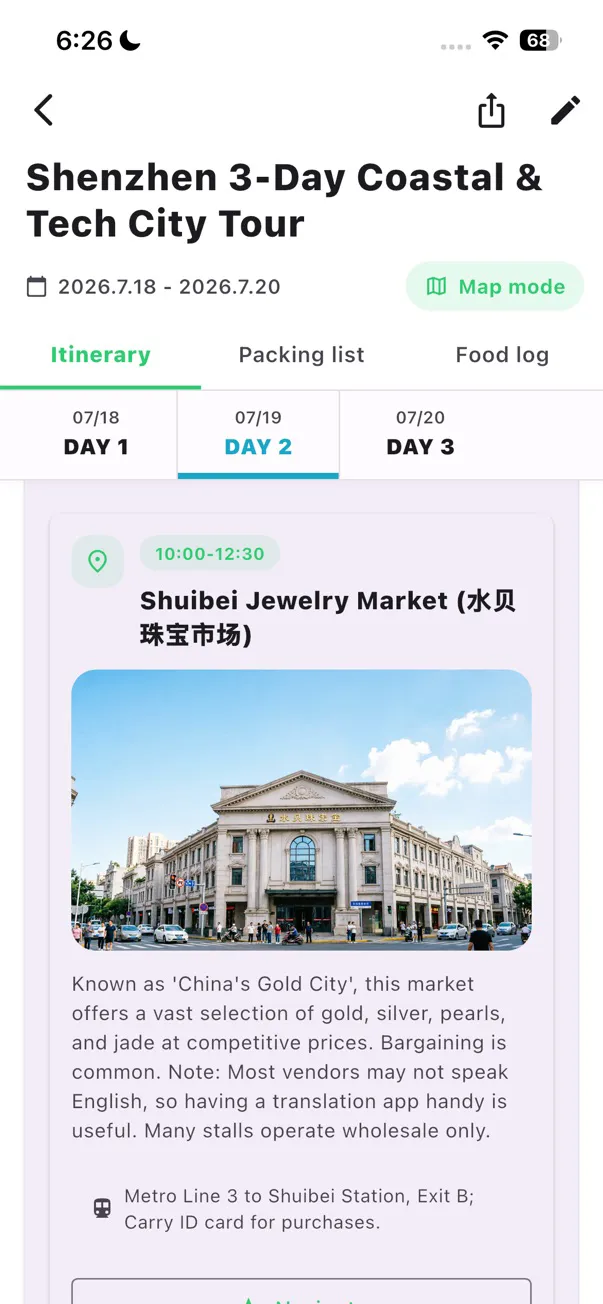
TravelPanda can import travel-plan screenshots and use a planning conversation to create a personalized day-by-day itinerary. Review every stop, then adjust the plan as dates, preferences, or confirmed bookings change.
Keep a verification layer beside the itinerary
Create a short checklist for facts that can change:
- official opening hours and closure days;
- ticket and reservation requirements;
- the exact station, terminal, or entrance;
- current transport schedule;
- weather and temporary closures;
- entry, health, or documentation rules relevant to your nationality.
Record when you last checked each important item. “Verified” without a date becomes unreliable quickly.
Make the itinerary usable on the street
A beautiful plan is not enough if you cannot use it when tired or offline. For each day, keep the essential version compact:
- the day's area and anchor booking;
- the first destination in Chinese and English;
- the route or station needed to reach it;
- two nearby optional stops;
- a meal idea and one dietary phrase if relevant;
- the hotel address and return plan.
Use a change rule during the trip
When something changes, protect fixed commitments first, then remove the lowest-priority flexible item. Avoid rebuilding the entire trip around one closed café or a short rain shower. The notes explaining why you saved each place make these decisions much easier.
A good itinerary is not the one that contains every screenshot. It is the one that preserves the experiences you care about while leaving enough room for the city to be real.